
Ssssh, toddlers on board
An interview by Jordi De Beule
A children's show that focuses primarily on tranquility? And that introduces preschoolers to the wonderful sounds of jazz in one fell swoop? BRIES, an interactive and visual theater concert, dreams of both. We spoke with drummer-composer Anke Verslype (known from aki) and director Simon D'Huyvetter about their unusual plans.
Anke, you are no stranger to the theater world. Last summer, you played drums in a performance by La Horde with none other than Sandra Hüller! With BRIES, you are now presenting your own children's show for the first time. A few years ago, you became a mother to a daughter yourself. Did that have anything to do with it?
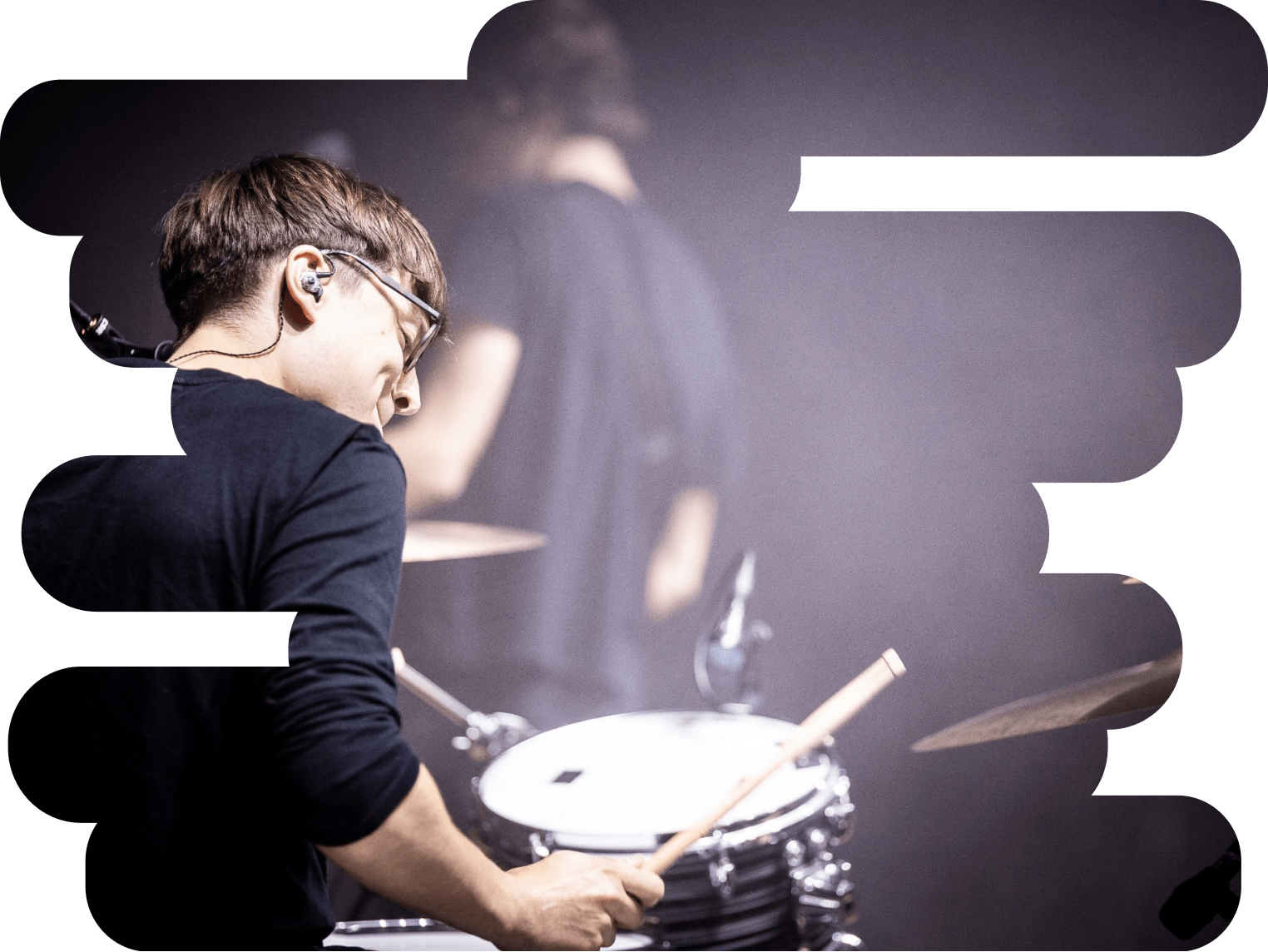
Anke: Maybe I took the step more quickly, but I've always been fascinated by children's experience of music. I combined my master's degree in music with an educational master's degree in which I did research on preschoolers and improvisation. After that, I also started teaching very young children. When I played music from my band aki, I noticed that they often responded well to it.
Simon: Don't you sometimes perform with your daughter's toys?
Anke: Haha, that's right. I work with a lot of percussion instruments that are actually meant for children. I once bought a bag full of instruments for my daughter and before I knew it, I had 'borrowed' half of them. Anyway, my students really responded to the music itself; it appealed to their imagination. That's how the idea of creating something for children gradually came about. So when Ha Concerts wanted to make jazz accessible to preschoolers, I didn't hesitate.

So BRIES' musical universe is moving in the direction of your work with aki; open, melodic, quiet jazz that evokes a lot of images?
Anke: That's right. Kapitein Winokio and the like are great fun, but I wanted to go in a completely different direction. Slower, quieter. I did ask myself: how do you keep the children's attention? It quickly became clear that you need a scenography that also stimulates the imagination and a director to engage the children. That's how Simon came into the picture.
Simon: I've been working at 4Hoog since 2023, a company that produces theater for children aged 3 and up. My job there is to develop the artistic vision, so I constantly ask myself: what is theater for young children today? What forms can it take? How can experimentation fit into it? The idea of a theater concert immediately appealed to me.
"For me, Gent is a city of profound connections: inspiring musicians & friends. Rehearsals for our tour begin tomorrow."
Wu Fei
Are you exploring the boundary between the two disciplines?
Simon: Indeed. We want to let children experience what jazz is and see how theater can play a supporting role in that. But everything starts with Anke's compositions, of course.
What theme did you work with for your compositions?
Anke: I was inspired by the cycles of nature. The rhythm of the days, nights, seasons... There's a kind of awakening in the music, then a more energetic piece, then we calm down again... I'm sure the children will hear a thousand other things in it, but for me it's about nature.
Simon: That also helped us with the scenography. We quickly decided that the children would sit on stage, close to the musicians, immersed in the music. That's why we're going to build four viewing islands, each around a different nature theme. For example, you can sit in a large nest, surrounded by branches and moss. When you enter, you should immediately feel amazed and safe. We also want to build in moments when you can move from one island to another. This allows the children to follow the performance from a different perspective each time and experience the sound from different heights and distances.
When Ha Concerts wanted to make jazz accessible to preschoolers, I didn't hesitate.
Anke Verslype
There will also be a lot to see. For example, there is a dancer. Was that different for you, Anke?
Anke: No, I knew that Carli Gellings could work with my music. When she heard it for the first time, she immediately saw all kinds of images.
Simon: Carli is actually a kind of free agent who shifts the focus. She can suddenly appear and grab your attention with her choreography. When she disappears, we are back in an auditory experience. So she actively determines how you watch and listen, and she also interacts with the children. Maybe even with the scenography. A major source of inspiration for this is Zoro Feigl, an artist from the Netherlands who creates living machines. Our scenographer Simon Van den Abeele is now looking into whether we can add a similar kinetic object. It would be an extra element for the dancer to perform a duet with.

I noticed that you studied film composition, Anke.
Anke: Yes and no. It was a little too computer-oriented for me, so I didn't finish it. But I've always enjoyed playing with images and sound. When I write music, I always see all kinds of things in my mind's eye.
We're curious about the animation that's also part of the piece. What role will it play?
Simon: I sometimes see jazz concerts where visuals are projected. I notice that the animation gives me a glimpse of something that's also in the music. If I drift off for a moment, it invites me back into that universe. Since everyone is on stage, we will probably work with a projection on the boards. Something very simple. At the moment, we see it as an interlude, something to watch during the moments when everyone changes islands. A kind of resting point.
Such a breathtaking indoor-outdoor venue in the heart of Amsterdam! I feel honoured to see all the photos of legends on the wall who have performed there. Big thanks to Simon, Louise, Dave and Wim for making this dream come true with me!
Wu Fei
It's clear that everything is geared towards calmness, slowness, and focus.
Simon: I think we all agree that there's a need for that. You know, if we're honest, we could also play tag on stage for 45 minutes, and lots of children would love that. But the question is, how do we offer added value?
Anke: I've played music in children's shows before, and it's often very intense. That's great fun, but I thought: how cool would it be to create a show that actually calms children down?
Simon: That's why we challenge ourselves in BRIES to dare to be repetitive, to dare to choose slowness, a slowness that is constantly shifting. That also appeals to children. I once played an international tour with a piece by 4hoog, and it was very physical. But there was also a moment when we fell silent and did nothing more than quietly build a tower out of crockery. Each actor came on stage with a bag, a saucer, a mug... and one by one they made the tower higher.
It became a kind of impossible balancing act of about a meter and a half of all these things hanging together. We had just played our hearts out, but it was actually at that moment that we had the children's attention the most. Through something very simple, refined. That's what we're looking for in this performance too: super clean images, minimalism, a certain dignity too. I'm really looking forward to that.
An audience of 3-year-olds seems unpredictable to me. Is there much room for improvisation?
Anke: Absolutely. I always leave room for that in my compositions. Wout Gooris, the pianist, is a fantastic soloist, and on the flute we have Nathalie van Mervenne, who actually comes from the classical world but can also play very freely.
Simon: But you do have a point. No matter how many pieces we've written for preschoolers, their reactions are always surprising, and tryouts remain indispensable for seeing what works. We want interaction, but where do we draw the line? We don't want a sterile environment, but we don't want chaos either. We still have to find the right balance, but that's also what makes it so exciting.
We're looking forward to it. Thank you!

Bries (3+)
Part of aHa! festival
Shhht, toddlers on board * musical theatre
15:00 Sold out
Bries (3+)
Part of aHa! festival
Shhht, toddlers on board * musical theatre
17:00 Sold out