
Nicolas Mortelmans immersed himself in the Indian sitar tradition for many years, along the banks of the Ganges in Varanasi. After studying the sitar in India, he moved to London to refine his playing with Anoushka Shankar, daughter of Ravi. Following MĀYĀ, an album with one foot in Indian culture and the other in Western culture, comes SPACE, an improvisational album recorded in a single afternoon with a selection of top Belgian musicians.
Interview by Stijn Buyst
When we ring the doorbell at Mortelmans' cottage in a forest on the outskirts of Lier, no one seems to be home. A few minutes later, he appears, wearing boxer shorts: we caught him fresh out of the shower. "Everyone always arrives late here, so I thought I'd go for a run. Come in and have a look around..."
The first thing we see is a cap from the legendary punk band Bad Brains, lying on the kitchen counter.
Mortelmans: I have been a fan of hardcore punk and metal my whole life. That will never change: I still go to shows regularly, it's pure therapy for me. In secondary school, I played guitar in various punk and metal bands. When I started travelling around the age of twenty, my taste in music broadened somewhat.
I became interested in other cultures and started playing all kinds of percussion instruments, such as the darbouka. I even spent some time as a Goa DJ. But I kept searching for the right instrument: I wanted to express myself, but hadn't yet found the right medium.

And then – this is not a romantic story – I saw a YouTube video of Ravi Shankar's concert at the Monterey Festival in 1967, with Alla Rakha on tabla. I watched that concert countless times. Then I knew: I don't know what this is, but this is it. I have to investigate this.
It encompasses so much: both slow, profound meditative pieces and highly technical, fast pieces that are almost as aggressive as speed metal. With my last five hundred euros, I bought my first sitar in a small shop on Turnhoutsebaan in Antwerp. I took lessons from Mark Senegal, an elderly sitar player in Ghent.
After a year, he said: if you really want to go deep, you have to go to India. And I thought, "fuck, I want to go deep."
Nicolas Mortelmans
And then you moved to India?
Mortelmans: My parents insisted that I study first. When I finally completed my degree in special education, I left. For years, I worked all year round and then spent four months in India every winter. To immerse myself completely. I lived with a musical family, without a laptop or mobile phone. Just in a small white room on a thin mattress.
Those music families are dynasties. Is it difficult to get into them?
Mortelmans: Since George Harrison moved there, there has been a huge influx of Westerners wanting to learn the sitar. If you show a genuine interest in the culture, they share their music with great love. I did pay for it – traditionally you don't pay for it there, so it was adapted for Westerners.
A musical family like this breathes and lives music. Immersing yourself in it is the perfect way to get to know that music.
It was getting up, attending classes, practising, going for a walk, eating, attending classes again, practising again and going to sleep. Months on end.
What about the tonality of a sitar, is it based on quarter tones?

Mortelmans: No, the notes are the same as ours. Quarter tones are used in Arabic music, but not in Indian music.
You work with whole and half tones, but because you bend the strings all the time – you can bend five tones from one fret – you do slide along those quarter tones all the time.
So those quarter tones are there, but you don't actually play them. The sitar is actually a solo melody instrument. There are twenty strings, but you play almost everything on one string. It is limited in itself: you have a range of three octaves, and you cannot play chords or harmonies. The sitar plays the melody/raga and the tabla plays the rhythm.
You must be able to sing everything you play: during those lessons, you are singing the entire time. Musical notation is rarely used, so you actually have to memorise everything.
How long did you study in India?
Mortelmans: I travelled to India from 2011 to 2017. I mostly studied in Varanasi, the city on the Ganges where they cremate bodies. One of the oldest cities in the world.
But I wanted to take lessons from a woman, and Anoushka Shankar seemed like the ideal teacher, partly because she has one foot in the West. It took me two years to convince her, but once I succeeded, I travelled regularly to London from 2017 to 2023 to study with her. She is also much more open to the fusion stuff I do.
Anoushka is the daughter of Ravi Shankar, the only sitar player everyone knows. Those are big shoes to fill.
Mortelmans: Ravi's journey is, of course, unique. He came here in the 1950s to bring Indian music to the West. But in her own way, Anoushka is continuing his work.

She also has one foot in traditional Indian music and the other in the West. She had to fight hard for it, because she was the daughter of.
She started touring at the age of thirteen, first with her father, then on her own. But I feel that over the last ten years she has been appreciated for who she is, and not for who her father was.
Is it even natural for women to make music in India?
Mortelmans: A bit more these days. But India is still a male-dominated culture. You wouldn't want to be born a woman there. It's a country of extremes; I've seen the most beautiful and the most terrible things there.
To give just one example: poverty is taboo here, but there it is something completely normal. You literally see people dying on the streets. But even the poorest are part of the system there, and every evening someone gives them a bowl of rice. Many people are repelled by these things. But there is also boundless beauty to be discovered.
India has shaped me as a person, simply because I have been there for so long.
Where do musicians actually stand on the social ladder in India?
Mortelmans: It took me a while to realise this, but classical Indian music, which includes sitar music, does have an elitist side to it. These musicians are therefore held in fairly high regard. But then you also have the Rajasthani folk musicians, who are much lower down the ladder. They are often poorer people who play on the streets, but are also hired for weddings and so on...
If you're going to study guitar or saxophone, you'll have your heroes to choose from. Do you have a favourite player in terms of sitar sound?
Mortelmans: With the sitar, there are countless gharānās, or regional styles. The two best known are the maihar ghāranā, from Ravi and Anoushka Shankar, and the etawah ghāranā. When I was in India, I was always told that you have to choose one style, that you have to follow one sitar player for life.

I did that for a while, to really delve deeply into one style, but now I've moved on from that. I think all those big names are fantastic. Depending on my mood, I choose one to listen to.
Ravi Shankar is one of them, but perhaps my favourite, who is also in the maihar gharānā, is Nikhil Banerjee. I also really like Shahid Parvez, who plays in a completely different style.
You made your first album, MĀYĀ, with a mix of Belgian and Indian musicians.
Mortelmans: I started working full-time as a musician in 2014 and played for ten years without releasing any music of my own. There are already so many good sitar players: why would I add another record to that? But then Covid came along, and I had nothing to do.
So I decided to make an album that was as broad as my own musical taste. It features classical sitar, but also electric sitar.
For each song, I chose musicians who I thought would be a good fit. Tarang Poddar played tabla and Ravichandra Kulur played flute – he played with Anoushka Shankar and with John McLaughlin.
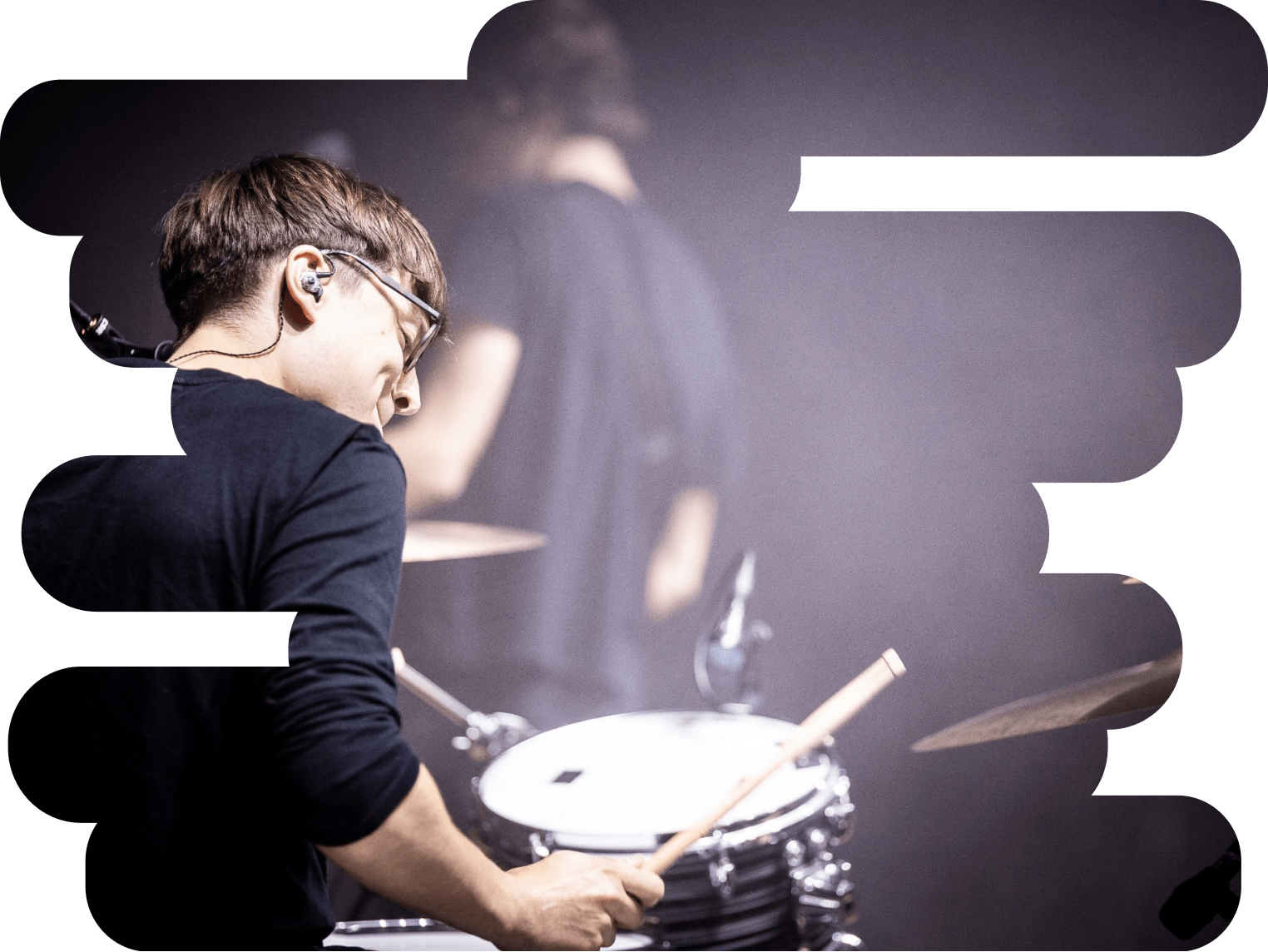
MĀYĀ features one track recorded with the same Belgian line-up that made the SPACE album: Roland Van Campenhout, Simon Segers, Tim Vanhamel and Stef Kamil Carlens.
Mortelmans: I wanted to have one track on MĀYĀ with a Western bass guitar and drum line-up, simply because I'm also a rocker. I was working with each of those musicians on various projects at the time.

That session for MĀYĀ was the first time we were in one room with those five musicians.
We just jammed for a day, without agreeing on anything. After that session, those men thought I should make a record out of it. That wasn't possible at the time, but it stayed in the back of my mind.
That record is out now, and you're playing it at Ha Concerts.
Mortelmans: That's right, except that Roland and Simon won't be joining us on tour: they're too busy with other projects. Teun Verbruggen will be replacing Simon.
Not bad, if your bench player is Teun Verbruggen.
Mortelmans: Fantastic drummer, indeed.
How did you actually meet Roland?
Mortelmans: I've been playing in his Space Cowboys band for quite some time now. The funny thing is: Roland has hundreds of guitars, but for that jam session he brought an old acoustic guitar with a single knob that makes the guitar sound like a sitar. I learned a tremendous amount from Roland and his fantastic musicians.
“Mentor” is a silly word, but without even realizing it, Roland is a huge source of inspiration.
Nicolas Mortelmans
SPACE is completely improvised. Are you going to play the record live or improvise again?
Mortelmans: Good question. It would be strange to play an improvised record. I would also like to start from scratch when performing live. It's exciting, because you're standing there virtually naked, with no compositions to hide behind.

Space Quartet (albumrelease)
Support: Head on Stone
Sitar psychedelics
20:15 Tickets