
Starting this autumn, Ha will focus on dialogue with the new series Re:Context. Because where has the conversation about music gone? How is musical craftsmanship or creation in general evolving in an ever-changing world?
High-profile authors of recent books on music and culture will be given a platform, with Lies Steppe as moderator and bassist Lara Rosseel providing a tailor-made soundtrack. We spoke about it with programmer Jaïr Tchong.
An interview by Stijn Buyst
Re:Context is a new series. Can you tell me something about the reasons behind it?
Jaïr Tchong: Jazz music originated from emancipation and engagement, but it has largely become music for people who have made their fortune. Many European jazz clubs are faced with an ageing audience.
I find that both ironic and bizarre, because it doesn't have to be that way.
Especially today, when there seems to be massive social fragmentation, it is good to talk about the social and societal significance of music.

Our idea to build a series around this took shape at our neighbours' bookshop Paard van Troje, which has a table with a wonderful selection of recent music books.
So let's invite leading authors from the sector to share stories about music in its broader context. This is relevant for everyone, and certainly for future musicians.
For example, the renowned author/producer Joe Boyd will be coming to talk. He not only discovered Nick Drake, but also stood next to Bob Dylan when he went electric and was there in the nightclub where Pink Floyd was born. The insights he can provide about the music world with all his experience seem priceless to me. I am already looking forward to the Q&A.
The range of music books available is enormous. How do you choose the books or authors on which to base a Re:Context evening?

Tchong: It's an experiment, of course; we're doing this for the first time. Personally, I find cultural history books very interesting, but we could also take a more practical approach. I recently read Liz Pelly's book about Spotify. Although it's more about technology, I would very much like to invite her because that technology has such an impact on all fronts: the listener at home, the musicians and the venues.
I think there are different types of books that would fit in the series. The one by singer Neneh Cherry is also on our wish list. Her biography, A Thousand Threads, shows how she sits at the intersection of post-wave, punk and free jazz.
Her performances at the time with the free jazz group The Thing still symbolise for me a unique, significant moment, in which different audiences could finally meet in a fantastic concentration of energy and expressiveness.
UK JAZZ
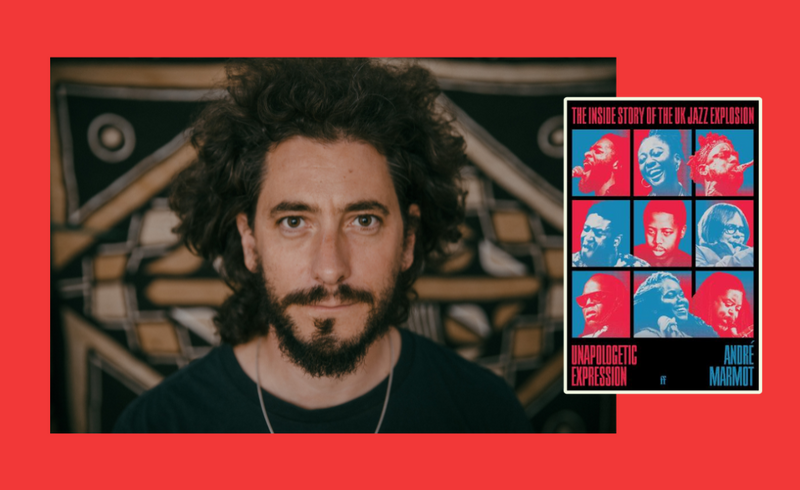
I read the first book mentioned, Unapologetic Expression by British promoter, musician and label boss André Mamot. This book, about the new generation of UK jazz musicians, clearly shows that the political element is – finally – back in full force among young musicians.

Tchong: Even without words, the most intense music can have a very political charge. Not that we want to turn Ha into a political action centre, but music is always more than just notes – it always takes place in a context.
Of course, as a beginning musician, you have to master your instrument before you can convey a message. But especially now that the world is in such turmoil, we must dare to look at the social significance of music.
Fortunately, music with a political message does not necessarily have to lose all its poetic power. I find Joachim Badenhorst a moving example of this. During his Zero Years Kid concert in Ha in December 2023, he planted a tiny Palestinian flag on the stage.
Tchong: That's exactly what I mean. Joachim also played during Eye on Palestine, which we organised together with our partners in Ha. It was one of the most beautiful evenings I experienced during my first year here. That evening was all about collectively sharing our concerns and despair.
I talked to Joachim about it at the time: 'We do this to come together and experience that emotion,' he said, 'and not to sit at home doomscrolling on our smartphones.' That collective aspect is an important reason why we do this work. There is much more significance attached to an evening like that.
The beauty of music is that it can immediately resonate with people, even without such an explanation. This is certainly true of improvisational music. But at Re:Context, we offer additional opportunities to get to know such music more closely.

Especially now that the world is on fire, we must dare to look at the social significance of music.
Jaïr Tchong
Tchong: The three scenes around which we are building the conversation – impro, world music and jazz – actually all have an image problem: young people often tend to see them as 'connoisseur music'. But when I saw Jaimie Branch play in Ostend, it transcended generations, genders and cultural backgrounds. There was a universal meaning in it, which I would very much like to strive for.
That is why we do not choose books by musicologists, which are often written for fellow professionals. What this first selection of three books has in common is that they are very well written and aimed at a general audience.
SPACE
Uit ‘Unapologetic Expression’ blijkt de belangrijke rol van vrijplaatsen zoals Total Refreshment Centre in Hackney, bij het ontstaan van een nieuwe scene.

Tchong: That "need for space" is essential. A scene can only bond if you have a very accessible venue. My great example in that regard is how the Bimhuis in Amsterdam works.
We are also looking at new ways to open up our building to the public, such as with the pop-up Backstage Bar this summer on the waterfront behind our building.
Jazz is also going strong in the United Kingdom at the moment, thanks to sufficient oxygen. I found it telling how Marmot describes how the 'Jazz Club' sketch from The Fast Show has permanently and thoroughly ruined the image of jazz for young Britons.
They have managed to turn that image around and reload the music with a crackling meaning that is also relevant to people with a migrant background.

Tchong: Exactly, that reminded me of my first visit to London in the mid-1990s. I went there at the invitation of the British-Indian duo Badmarsch & Shri. The Asian Underground movement was at its peak there at the time, with a mixture of drum 'n' bass and Indian influences.
I spent three days with journalist Andy Morgan, going from super highbrow clubs to very seedy underground venues. You could really feel that it was a cohesive scene, made up of musicians from the second generation of immigrants, including many female DJs.
Marmot argues that the most significant non-American jazz movements always incorporate elements of their own culture: Ghanaian highlife, South African township jazz by Dollar Brand, the Scandinavian scene, and, consequently, UK jazz musicians who draw on their migration backgrounds. What could that be for us?
Tchong: That's an interesting observation. I know for a fact that my favourite Belgian jazz projects don't sound like foreign examples. Donder, for example, is completely unique, and you can tell that foreign programmers recognise that too.
I find Lander & Adriaan equally unique, who in an enormously erudite way bring decades of electronic dance music together into something completely their own.
Outside of jazz, Aksak Maboul remains an inspiration to me. Their music could only have been created in Brussels at that time, and ranged from imaginary 'world' music to contemporary chamber music and improvisational jazz.
The way they worked with Congolese influences and Turkish odd time signatures was something no one else was doing at the time. For me, their first album is absolutely on a par with My Life in the Bush of Ghosts by David Byrne and Brian Eno.

Something else that blew me away recently is how Ben LaMar Gay creates a kind of ritual space live, suddenly bringing the festival audience into a kind of collective focus.
I strongly believe that music is the best way to teach people what focus is. Ideally, I would create a large cabinet where people can drop off their smartphones before entering the venue.
JOE BOYD
Let's talk about Joe Boyd for a moment. His 'And the Roots of Rhythm Remain' is the subject of the second Re:Context evening.

Tchong: Boyd is, of course, world famous. With Hannibal Records, he brought Congolese, Eastern European and Malian music to the attention of a wide and global audience.
In fact, you could say that he always broke through the traditional marketing ideas of the mainstream music industry and managed to put the music back at the centre.

'And the Roots' is Boyd's magnum opus, in which he connects many different phenomena in a highly infectious and well-founded manner. I find the passage about his role in Paul Simon's Graceland particularly interesting, because that album documents the authentic artistic discovery of all those South African music genres.
At the time, it was claimed that Simon was 'wrong' because he broke the boycott, and he was really vilified for it. But it remains a brilliant album, with so many layers. That album opened so many doors, including for South African musicians.
To conclude, let's return to the involvement of the younger generation. You recently organised a workshop with Sungazer, where students from KASK & Conservatorium could talk to Adam Neely and Shawn Crowder. How was that?
Tchong: We were very happy with that afternoon. From the start, the students were extremely engaged. They immediately asked interesting questions, such as 'why is the curriculum of jazz programmes so Western-oriented?'.
When I asked Neely how he saw the urgency for socially engaged jazz in America today from his perspective at Sungazer, he started with a fairly standard answer, but then stopped because he felt he needed to give a more personal answer to that question. He said he is married to a woman of Latin American descent and that while he was touring Europe for two months, she sat at home alone every night, terrified of the doorbell ringing. Even people with valid papers are now being arrested in America. The silence in the room was deafening...
For me, that is a perfect example of why we, as a music venue, can no longer keep politics out of the door.