An identity straddling two worlds
1958, Essex. Five-year-old Pauline Black has just learnt that she is adopted and vomits the entire contents of her stomach onto a pile of freshly ironed bed linen. So much for the opening scene of ‘Black by Design’, the autobiography in which Black looks back on a life in which she has reinvented herself time and again – from a child of colour in a white environment to a key figure in the British 2-Tone movement, a television presenter and an award-winning actress.
She doesn’t necessarily feel unloved, but describes her family situation as that of a cuckoo’s chick.
Stijn Buyst
Pauline Black was born in 1953 as Belinda Magnus, to a Jewish mother and a Nigerian father, and was adopted immediately after her birth by a white middle-class family, where she was given the name Pauline Vickers. In 'Black by Design', Black speaks candidly about how racism is deeply ingrained even within her own adoptive family, yet remains unspoken. Her mother, in particular, is terrified that Pauline will one day bring a black boyfriend home (which, of course, is exactly what happens).

But in her memoirs, Black also cherishes the memory of how her father stood up for a colleague from the Caribbean who had been unfairly criticised. Vickers struggles with her identity in a family where she gradually begins to feel blacker, yet this is invariably glossed over as ‘of colour’. She does not necessarily feel unloved, but describes her family situation as that of a cuckoo’s chick.
When the time is right, she spreads her wings and moves to Coventry to study, where she joins the Workers’ Revolutionary Party and becomes captivated by the civil rights movement. After completing her studies, she starts working as a radiographer in a hospital, but in the meantime she has taught herself to play the guitar using a Leonard Cohen songbook and begins to perform tentatively in folk clubs and cafés, which lands her a spot as the support act for Bert Jansch.
THE SELECTER
Around that time, Coventry was also the epicentre of the newly emerged 2 Tone movement, named after the record label of the same name, featuring bands such as The Specials and Madness, who injected their ska revival with a hefty dose of punk. 2 Tone is party music, but it always carries a political message, starting with the make-up of the bands. Whilst mixed-race groups were virtually non-existent in 1979, this was the standard formula for 2 Tone.

Through a series of connections, Vickers ended up at the home of Neol Davies, a guitarist who urgently needed to put a band together to capitalise on the success of his instrumental ‘The Selecter’ (the B-side of The Specials’ single ‘Gangsters’). Vickers’ vocals proved to be the final piece of the jigsaw that The Selecter needed.
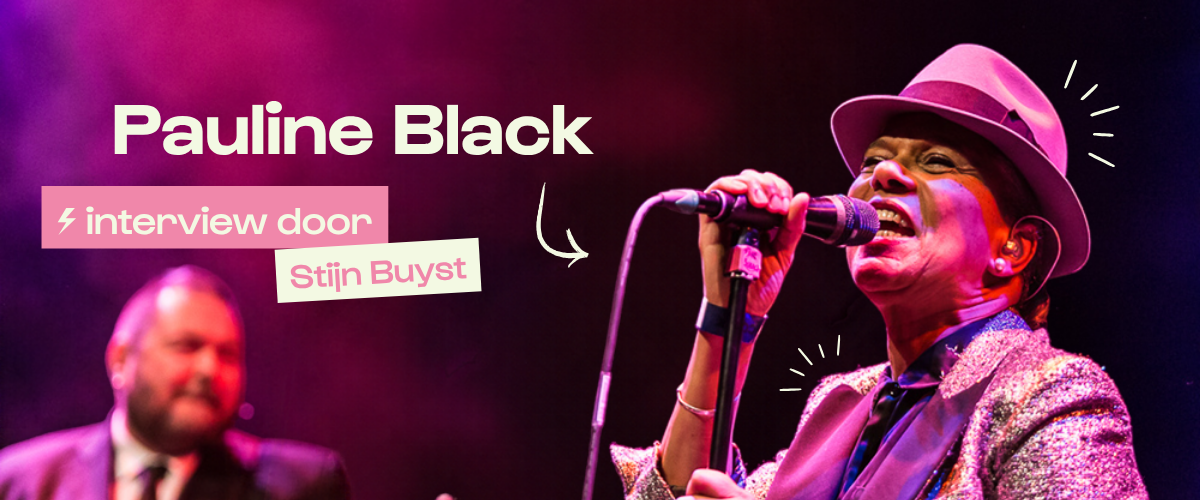
If The Specials were the originals of 2 Tone, and Madness opened the door to the wider public, then The Selecter – no horns, but guitars and Desmond Brown’s Hammond organ – were the punky little brother. Vickers renamed herself Pauline Black and, in one fell swoop, came up with her ‘Rude Girl’ outfit: a tight-fitting suit and a trilby – or pork pie – hat.
The Selecter signed with 2 Tone Records, followed by TV appearances, and their single ‘On My Radio’ peaked at number eight in the UK Singles Charts. This is followed by the legendary 2 Tone Tour, which takes The Selecter, The Specials and Madness across Great Britain, and subsequently to the Netherlands and Belgium, amongst other places. For vivid vignettes of the situations and characters involved in that tour, read ‘Black by Design’.
On stage
When The Selecter burned out after a few intense years and went into a long hiatus, Black found herself on the theatre stage and on television sets. She began working as a journalist for the Channel 4 programme Black on Black, for which she interviewed a host of personalities: Eartha Kitt, Yellowman, Gill Scott-Heron, Linton Kwesi Johnson, Afrika Bambaataa, Fela Kuti… She wisely turned him down when he proposed that she become his twelfth wife.
Ahead of the 1984 US presidential primaries, she travelled to the United States to follow Reverend Jesse Jackson on his campaign and met several of the pioneers of the post-civil rights movement whom she so admired.

Throughout this time, she continues to act, which leads, amongst other things, to an encounter between Black’s adoptive brothers and the star actress Vanessa Redgrave that is as hilarious as it is painful. In 1991, she received the Time Out Award for Best Actress from John Malkovich for her portrayal of Billie Holiday. It would not even turn out to be her greatest honour, for in 2022 King Charles appointed her an ‘Officer of the Most Excellent Order of the British Empire’.
However many starring roles and awards she may receive, Black continues to encounter racism, right up to the moment when, in the toilets of a posh establishment, she is ordered by a ‘lady’ to change the toilet paper, whilst she is, of all things, admiring a freshly bought Prada jacket in front of the mirror. For Black, this was the catalyst to finally set out in search of her biological parents. You’ll likely hear about the explosion of surprises that followed in the Re:Context discussion preceding The Selecter’s concert.
The first Selecter reunion took place in 1991, at which point Neol Davies was still in the line-up, though he left shortly afterwards. Original drummer Charley “Aitch” Bembridge will, however, be joining them at Ha Concerts. So, party like it’s 2026!

Re:Context with Pauline Black
Artist talk before the concert
A look at the iconic frontwoman of The Selecter
19:30 Free with reservation
The Selecter
Celebrating 45 years of 'Too Much Pressure'
The Queen of Ska
20:15 Tickets